
AFAM: Hello Yann and thank you for agreeing to answer our questions. You are currently working jointly with NASA Jet Propulsion Laboratory, in Pasadena, CA, on the Development of Instrumentation for Astrophysics and Observational Cosmology. Please tell us more about your work for this project.
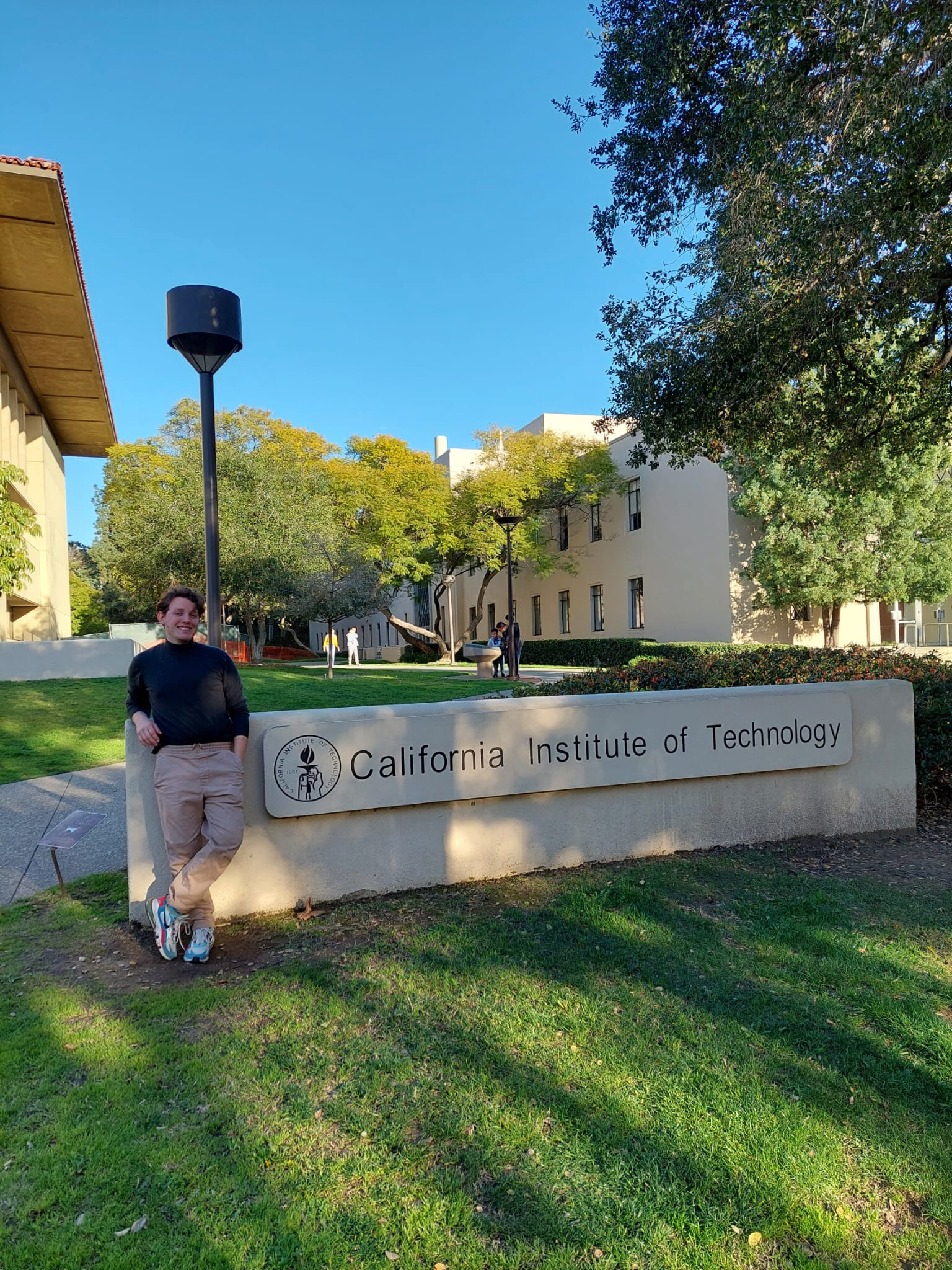
Yann: Hello and thank you for having me, it is a pleasure to answer your questions. My work at Caltech involves developing advanced cryogenic structures to optimize optics for astrophysical and observational cosmology instrumentation. More specifically, I collaborate with NASA’s Jet Propulsion Laboratory on enhancing Microwave Kinetic Inductance Detectors (MKIDs), which are cutting-edge superconducting sensors used in ground-based observatories and space satellites. These detectors play a great role in observing faint cosmic signals and we use them at the Caltech Submillimeter Observatory in Hawaii to study stellar and massive galaxy cluster formation, their interaction with the Cosmic Microwave Background, and other phenomena from the early Universe. My job is to ensure that their performance is maximized through thermal management and structural design. Additionally, I contribute to a phonon-mediated dark matter detection instrument using MKIDs, focusing on designing the cryogenic structure and the electronics to enhance sensitivity and accuracy. My work is basically a mix of physics, engineering, and space sciences, and it’s incredibly rewarding to see how these contributions can help understand some of the greatest mysteries of the Universe.
AFAM: before your work as a researcher for CalTech, you spent 2 months at NASA as a volunteer research assistant. Could you please tell us more about this opportunity that you had? In our Shasta program every year, we have students who are looking for internships in the aerospace industry. Do you think an internship at NASA could become a reality for some of them? What kind of background/skills/experience do they need to have in order to achieve it?
Yann: Yes, during my time at Caltech, I was invited through the internal network to volunteer on the preliminary phase of the LISA mission (Laser Interferometer Space Antenna). Alongside other scientists, we assessed various technical and scientific aspects of this mission aimed at detecting gravitational waves in space.
An internship at NASA can absolutely become a reality for students aspiring to a career in aerospace. There will always be a place for talented and passionate students ! To secure such an opportunity I think students should focus on excelling academically particularly in areas such as mechanics, electronics, space sciences, or systems engineering while seeking out hands-on projects and research opportunities. The multidisciplinary training at Arts et Métiers equips students with hands-on experience and a problem-solving mindset that are highly valued in the aerospace industry. Beyond technical skills, the ability to work effectively in teams, adapt to complex challenges, and communicate ideas clearly are essential qualities.
AFAM: how come that you decided to become a space systems engineer? What was the turning point and your road leading to this?
Yann: My journey to becoming a space systems engineer began with a childhood fascination for the night sky. Growing up, I was captivated by space exploration, watching documentaries, reading books, and sketching spacecraft designs. The turning point came in 2016 during my first year of Preparatory Class in France, when I enrolled in the Universpace Summer Program organized by CNES. This program was a transformative experience: I learned about the vast possibilities of the aerospace field and connected with experts and astronauts like Thomas Pesquet for the very first time. It was during this time that my passion for space truly took root.
Following my engineering degree at ENSAM, I pursued an advanced master's degree in Space Systems Engineering at ISAE-SUPAERO. While there, I participated in the SpacE Exploration and Development Systems (SEEDS) program, a collaboration with the European Space Agency (ESA). As part of the program, I worked on developing a lander to support future human space exploration missions on Mars, as well as a concept for a European commercial space station in Low Earth Orbit. Collaborating across Europe with teams of engineers and space professionals was truly a revelation for me. Then I had the amazing chance to be recommended to work at Caltech.
AFAM: how did being a Gadz’Arts help you in your professional life and career?
Yann: Being a Gadz’Arts is much more than just receiving a strong technical education, it’s about belonging to a community that truly supports you every step of the way. The Gadz’Arts network has been a constant source of help and encouragement throughout my journey. Whether during my studies or while working in different countries, I’ve always been able to count on the guidance and assistance of fellow Gadz’Arts. This sense of solidarity and mutual aid is one of the defining features of our community and has played a crucial role in shaping my career. Knowing that you’re part of a network where everyone is ready to lend a hand makes all the difference, both personally and professionally.
AFAM: What are your plans for the future ( if you could tell us a bit more about it)?
Yann: My immediate focus is on completing my ongoing projects at Caltech and JPL. In the long term, I aspire to lead innovative missions in space exploration with agencies like NASA or ESA. My ultimate dream is to one day pass the ESA astronaut selection process and play an active role in human space exploration missions. Beyond that, I hope to inspire and mentor the next generation of engineers and researchers, whether through academia or outreach programs, sharing my passion for space and the possibilities it holds.
AFAM: you live in Pasadena. Can you tell a bit more about your life in California? What are you doing in your free time?
Yann: Pasadena is a vibrant and inspiring place to live, especially for someone passionate about space exploration. In my free time, I enjoy hiking in the nearby San Gabriel Mountains, exploring California’s beautiful nature, traveling and surfing. I also spend time connecting with the local scientific community and attending public lectures or events at Caltech, JPL or The Planetary Society. On quieter days, I love getting lost in a good book, trying out new cooking recipes, and spending time with animals through pet sitting or in abandoned animal fosters.
AFAM: thank you for your time and good luck with all your future endeavors!
Pictures: courtesy of Yann
Other interviews in “Ad astra” series:
interview # 1 with Jean-Christophe Boulon (Me 213)
Interview #2 with Laurène Rokvam (Bo 210)
 BLOG /
  CALENDAR /
  DONATIONS /
  MENTORS /