
AFAM: Hello Florian and Jean-Louis, and thank you for sharing your experience of being Georgia Tech students (parcours US). Please tell us a few words about yourself, what are you doing now?
Jean-Louis:
My name is Jean-Louis Roy. I studied at Arts et Métiers before joining Georgia Tech, where I recently completed a Master’s degree in Electrical and Computer Engineering. My academic interests are mainly at the intersection of engineering, machine learning, optimization, and applied technology. I am now exploring professional opportunities where I can combine technical problem-solving with real-world impact.
Florian: Hi, I just finished my Master of Science in Electrical and Computer Engineering at Georgia Tech in Atlanta. I did this as part of the “Parcours US” program at Arts et Métiers. I just came back to France to do my final-year internship.
AFAM: Why did you decide to apply for Georgia Tech program (parcours US)?
Jean-Louis:
I decided to apply because I wanted to experience a more international and research-oriented academic environment. Georgia Tech was also a great opportunity to study in the United States, improve my technical background, and discover a different way of learning, with more projects, teamwork, and practical applications. It felt like a strong complement to my engineering education at Arts et Métiers.
Florian: I wanted to specialize in AI while still benefiting from the general engineering training offered by Arts et Métiers. The Parcours US program allowed me to apply to several American universities offering these master’s degrees, and I ultimately chose Georgia Tech.
AFAM: How did you like Georgia Tech in Atlanta? What classes were you enjoying the most?
Jean-Louis:
I really enjoyed my experience at Georgia Tech in Atlanta. The campus is very dynamic, and you can feel that students are involved in many academic, entrepreneurial, and extracurricular projects.
Among the classes I enjoyed the most, I would mention High-Dimensional Statistics. It was very demanding and technical, but also intellectually stimulating and strongly connected to modern data science and machine learning.
Florian:
It was a really good experience. Living on campus is very pleasant; everything is accessible and designed for students. The most interesting classes were the theoretical courses in statistics and machine learning, such as High-Dimensional Statistics and Graphical Models, but they were also the most difficult ones.
AFAM: What was the most challenging for you in the US?
Jean-Louis:
One of the most challenging parts was preparing the practical aspects of life in the US before arriving, especially housing. Fortunately, we had the support of the Graduate Living Center (GLC), because otherwise finding and renting a place remotely, without visiting it beforehand, would have felt like a real leap of faith.
Academically, the workload was also quite demanding. There were many homework assignments and projects throughout the semester, so it was important to start early and stay organized instead of waiting until the last minute. I also chose to complete my degree in two semesters, from Fall to Spring, instead of spreading it over three semesters including the Summer. This made the workload even more intense and required stronger time management.
Florian:
I think the most challenging thing for me at the beginning was approaching Americans to ask for information or help, because it can feel a bit intimidating. But you just have to go for it, even if you have to repeat yourself several times; it’s not a big deal.
AFAM: How was life on Georgia Tech campus? Any activities you were enjoying outside of the classroom?
Jean-Louis:
Life on campus was very active, with many events, student organizations, sports activities, and opportunities to meet people from different backgrounds. Personally, I did not take part in one specific activity on a regular basis, but I really appreciated the quality of the campus facilities, especially the gym, swimming pool, sauna, and sports areas.
For students who want to join clubs and integrate more quickly, I would recommend looking for opportunities early and being proactive. The same applies to students interested in research: it is better not to wait for opportunities to come naturally, but to reach out, ask questions, and take initiative. In my experience, this proactive mindset is strongly valued in the US.
Florian:
Life on campus was great. Georgia Tech has amazing facilities, whether for studying, sports, or student life in general, and it really feels like everything is designed to make students’ lives easier. I also played volleyball before arriving at Georgia Tech, and one of my motivations for going to the US was the sports facilities and the sports culture. So I joined the Georgia Tech volleyball team. It was my best experience there. It allowed me to make real American friends, travel around the US for tournaments ( California, Florida, Alabama ) and experience Nationals in March. If you have a good level in a sport, don’t hesitate to try out for club teams, even if it is only for one semester.
AFAM: Anything you would like to share about your future projects?
Jean-Louis:
For the future, I would like to work on projects that combine engineering, data, and artificial intelligence, ideally with a strong practical impact. My experience at Georgia Tech confirmed my interest in technical fields such as machine learning, optimization, and applied systems.
More broadly, I hope to keep building an international profile and use what I learned both at Arts et Métiers and Georgia Tech in ambitious technical projects.
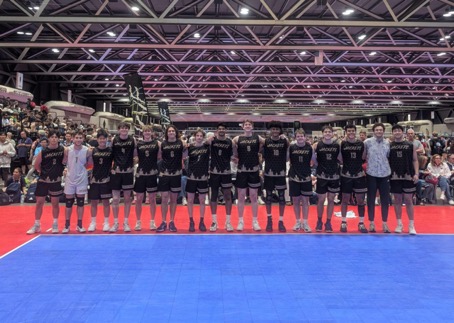
Georgia Tech volleyball team

Atlanta at night
Photos: courtesy of Florian and Jean-Louis
Please discover Sequoia coaching program and Sequoia grants offered by AFAM. If you are an Arts et Metiers student, you can be eligible to participate.
 BLOG /
  CALENDAR /
  DONATIONS /
  MENTORS /