
AFAM: Hello Henri, and thank you for agreeing to answer our questions. You are currently a Research assistant at David Rittenhouse Laboratory (University of Pennsylvania). Please tell us more about your role and the journey that led you to it? How come that ( and when) you became interested in astronomy?
Henri:
Hello Albina,
I am happy to answer these questions if it helps other students. I am currently interning in the Department of Physics and Mathematics at UPenn specifically within the David Rittenhouse Laboratory, which focuses on cosmology and the study of the universe's "first light" (dating back about 14 billion years). Coming from an engineering background, I don't work directly on astrophysics itself. Instead, I am developing a tool to assist the researchers. Indeed UPenn, in partnership with many other universities worldwide, recently acquired a telescope in Chile (the Simons Observatory Large Aperture Telescope) designed to study these light rays. However, a calibration issue arose regarding the two mirrors (primary and secondary) used to direct light toward the receivers. Gravity and heat can cause the mirrors to shift slightly, completely skewing measurements because the further out you observe, the more significant the impact of even a tiny angular error becomes.
For the past three months, I have been working on a method to measure mirror positioning using photogrammetry. This involves setting up a network of cameras that, by combining multiple viewpoints and using triangulation techniques, allows us to move from 2D (like a standard photograph) to 3D, enabling us to track the mirrors' displacement.
This internship was something I gravitated toward over time. I have always had a strong interest in cosmology; it is a complex, emerging field that compels one to consider both scientific and philosophical questions. After all, studying the universe's first light inevitably leads us to ask what existed before it and what will come after. So, when I decided I wanted to do an internship in a university lab, I told myself that since I would only be there for a few months, I might as well do something that truly inspired me and took me out of my comfort zone; naturally, I chose astrophysics. All I had to do then was find laboratories in the field and send unsolicited applications via email, highlighting my background and past experiences.
AFAM: every year we have students looking for internships in the United States? Why do you think you were a successful candidate for the role at David Rittenhouse Laboratory? What piece of advice would you give to students interested in finding an internship in the United States?
Henri:
I believe my application was accepted by the laboratory for several reasons that didn't necessarily hinge on the U.S. context itself. First, I carefully targeted the labs I wanted to apply to by looking at how my profile specifically aligned with their needs. I researched their fields of study and made sure to present myself naturally as a compelling candidate. Additionally, alongside my background at Arts et Métiers, I had the opportunity to pursue a computer programming curriculum at École 42. This allowed me to easily highlight the dual nature of my profile combining mechanical engineering with computer engineering skills. I also think I stood out because I used that initial email as a hook, clearly stating that I was 100% self-sufficient, which reassured them that administrative procedures wouldn't be an issue. Once the hook worked and the video interview was scheduled, I was able to show my true self, as it is easier to build a rapport via video call than through email. Finally, once I sensed that my profile was a good fit and that I got along well with the researchers, I was able to negotiate certain terms.
I would say the key factor is a gradual approach; hiring a foreign student isn't necessarily easy for an American university, given the lengthy administrative processes and the competition from American students who are easier to hire but also want these internships. You need to emphasize that hiring you is their best option and that you are fully prepared to handle the administrative requirements. You also need to be available and organized regarding interviews, video calls, and emails, despite the time difference.
AFAM: You became a Mayoux-Dauriac 2026 ( Paris campus)? Congratulations! Please tell us a bit more about your different interests outside of experimental cosmology?
Henri:
Haha, yes that’s right, I won the 2026 Mayoux-Dauriac Prize, and I’d like to thank everyone involved in organizing it each year once again. It is a truly enriching event, both for the stylistic challenge it offers and for the €1,000 prize I was able to win.
I am indeed a student with a keen interest in the sciences particularly physics but I also have a passion for the humanities, especially the art of rhetoric, counter-argumentation, and debate. As I mentioned earlier, one of the things I find so appealing about cosmology and astrophysics is the way these fields prompt us to question things and lead us into complex, mind-bending philosophical reasoning. I am also an avid athlete who enjoys setting medium-term goals, striving to achieve them and then moving on to new ones.
AFAM: how did being a Gadz’Arts help you in your professional life so far?
Henri:
To be completely honest and setting aside the absolutely brilliant support from AFAM being a Gadz'Arts hadn't really helped me in my professional life up so far. I have no doubt that it will one day, though, because the Arts community, thanks to its alumni, possesses a truly unique spirit of mutual support.
AFAM: What are your plans for the future (if you could tell us a bit more about it)?
Henri:
I must admit that my plans for the future aren't entirely clear yet. My experience here at UPenn has been absolutely incredible on a personal level. I’ve learned a great deal about astrophysics research and how a laboratory operates, but I’ve also learned a lot about myself. Consequently, after this internship, I plan to step away from research for a while and pursue other paths. To start, I’ve applied to become an officer in the French Army through a partnership between the military and various French engineering and business schools (the Partenariat Grandes Écoles). I am currently awaiting the final results, but this opportunity would allow me to spend six months split between the Saint-Cyr military academy and an assigned regiment. Beyond that, the future is less certain, I might apply for a public policy program to work in the civil service, bringing an engineering perspective to issues like climate change and technological sovereignty. Another option would be to pursue a career in core engineering within the defense sector.
AFAM: you live in Pennsylvania. Can you tell a bit more about your life outside of work? What are you doing in your free time?
Henri:
Yes, I was lucky enough to live in Philadelphia and right in the middle of the 2026 World Cup, no less. The atmosphere was truly special, and I’m so glad things worked out that way, because I think the vibe there was genuinely unique. Outside of work hours, I had the chance to explore New York (an hour and a half away by train) and Washington (two hours away), visiting all the fabulous museums and monuments in those cities, in addition to the ones in Philadelphia. During the week, I work out a lot at the campus's many gyms.
AFAM: thank you for your time and good luck with all your future endeavors!
Pictures: courtesy of Henri
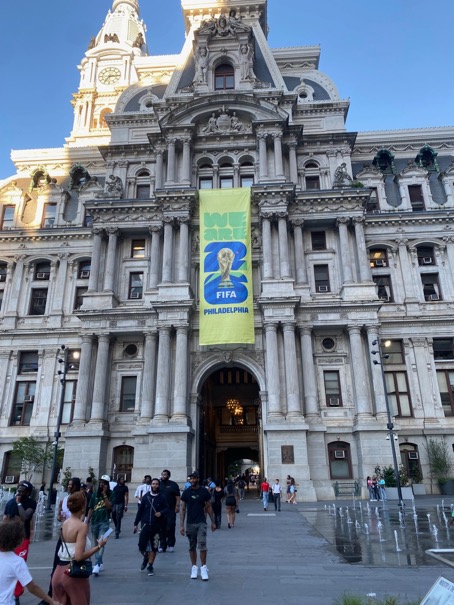
Philadelphie - City hall
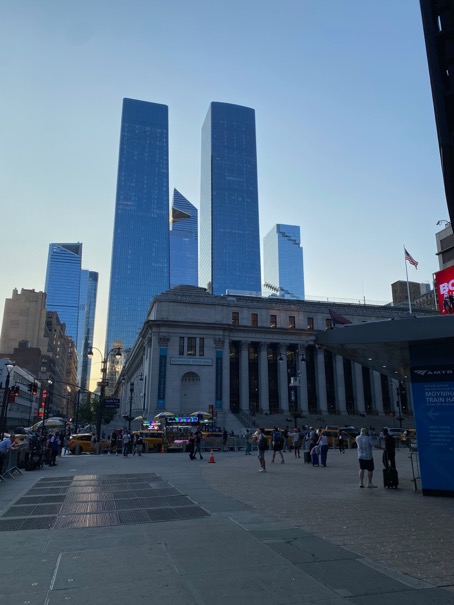
New York - Train station
Other interviews in “Ad astra” series:
 BLOG /
  CALENDAR /
  DONATIONS /
  MENTORS /