
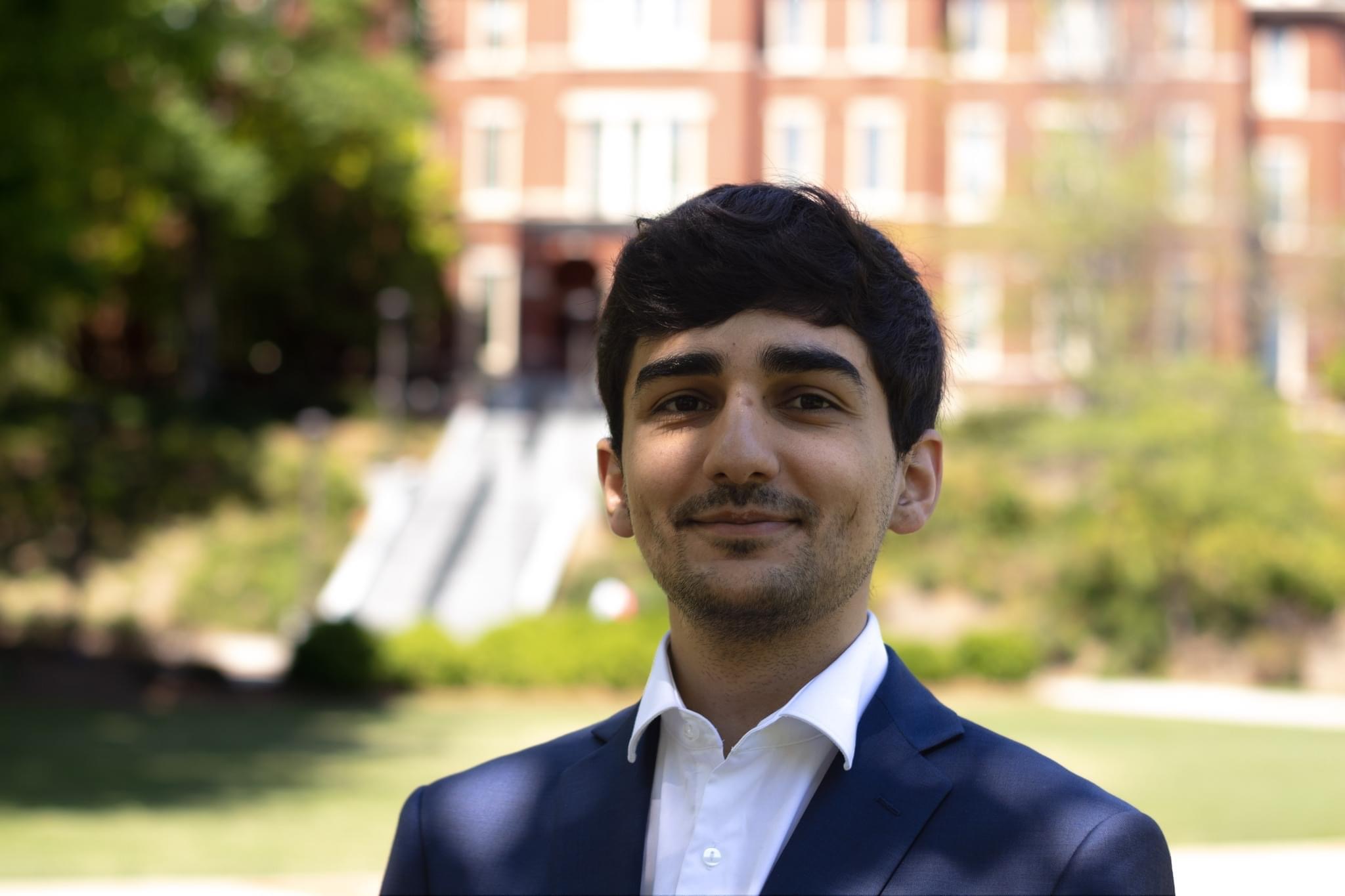
AFAM: Hello Yassine, and thank you for agreeing to answer our questions. You are currently a PhD Candidate in Astrophysics at GeorgiaTech. Please tell us more about your research project and what led you to it? How come that ( and when) you became interested in astrophysics?
Yassine: My interest in astrophysics dates back to my childhood. In middle school, I was given a limited edition of Science et Vie Découverte about black holes. I found it mesmerizing to read about an object so extreme that it could warp space and time itself, and I quickly became captivated by these objects. Over time, I read more widely about the universe, cosmology, and galaxies, and this curiosity grew into a genuine passion for astrophysics as a field. This passion became a driving force throughout my studies. As my results at the time did not allow me to pursue this path directly, I turned to aerospace engineering as an alternative route.
During my final spring semester as an aerospace engineering student at Georgia Tech, I took a course in general relativity with Dr. Dimitrios Psaltis and began a research project with him over the summer. By the following fall, after presenting my results, I was offered the opportunity to enroll in a PhD program in astrophysics under Dr. Feryal Özel, with the goal of developing requirements for future missions to observe black holes, building on the results of the Event Horizon Telescope that produced the first-ever images of these objects.
My work focuses on understanding the requirements that future missions must meet to obtain the most informative images possible, in order to advance our understanding of general relativity and plasma physics. My research is organized into three complementary components.
A common way to observe black holes is to use interferometers that detect emissions in the radio part of the spectrum. Because interferometers can only sample a limited number of points, the first aim of my research is to determine which of these points are most critical to producing physically accurate images, and how machine learning can be used to extract the maximum amount of information from each one in order to reconstruct an image (https://doi.org/10.48550/arXiv.2412.01908).
Because image resolution depends on the distance between telescopes, a natural extension of the work carried out on Earth by the Event Horizon Telescope is to place interferometers in space. Building on the knowledge I have developed about optimal signal coverage and orbital mechanics, I then formulate requirements for future space missions to achieve the best possible coverage of the signal (https://doi.org/10.48550/arXiv.2412.01904).
Finally, building on these requirements and the image reconstruction process we have developed, I explore new ways to test our theories of general relativity using these images, as well as new physics related to plasma dynamics, jet launching, and the electromagnetic counterparts of gravitational wave emitting binary systems.
This whole effort serves as a basis for a tentative NASA MIDEX scale mission called SPRITE (SPace Radio Interferometric Telescope Explorer) whose PI is my advisor, Feryal Özel (https://physics.gatech.edu/news/georgia-tech-hosts-kickoff-space-bound-black-hole-imaging-mission). It is very exciting to be an integral part of a project that brings many scientists and engineers together to push the limits of what’s technically feasible in black hole observation.
The SPRITE mission will officially be presented at the International Astronautical Congress 2026 (IAC 2026) so stay tuned and don’t miss our paper on it if you’re interested!
AFAM: before your work as a researcher, you were interning for NASA. Could you please tell us more about this opportunity that you had? In our Shasta program every year, we have students who are looking for internships in the aerospace industry / research. Do you think an internship at NASA could become a reality for some of them? What kind of background/skills/experience do they need to have in order to achieve it?
Yassine: When I joined the aerospace engineering program at Georgia Tech, I was offered a Graduate Research Assistantship in the Aerospace Systems Design Laboratory. During my time there, I was assigned to a NASA research project on emissions from supersonic civil aircraft on which I was elected as chair of the student committee across the multiple institutions taking part to this research. After a year of biweekly meetings on this project, requesting an internship felt like a natural next step. Looking back on that experience, I would say this kind of internship is achievable once a first contact has been made, although positions for foreign nationals remain quite limited.
Without an existing point of contact, the competition is fierce, but I believe our French education equips us with skills that are in high demand. One of them I was shocked to learn about is the use of Python for scientific computing which is taught very early in French curricula but not in the US. Being able to quickly and accurately implement simulation models and explore research paths efficiently brings a lot to the table. Of course, taking full advantage of such skills implies that you are at ease when it comes to presenting an idea and convincing an audience. Also showing curiosity and honesty is extremely valued. It is always better to say « I don’t know but I’ll learn and look for an answer quickly » than pretending to know and being misled by a partial knowledge.
Now I will agree that these are rather generic facts but there is no true magic formula just perseverance, honesty, hard work, and also (unfortunately if you ask me...) luck. But this luck can be forced upon you by taking on challenging projects and aiming for leadership/representative positions to shed a light on your skills.
AFAM: how did being a Gadz’Arts help you in your professional life and career?
Yassine: Being a Gadz'Arts gave me a great deal on a personal level. Skills such as communication, teamwork, and project leadership were all shaped by the time I spent with my cohort. The perseverance that we value so much in our traditions is also a major key to success in my opinion because in an American environment, things are much less enclosed into tracks and frames than in France. There are lots of opportunities to do what you want and become who you want no matter what your background is, provided that you put in the work to adapt and show enough resolve to convince people that you are capable.
Being a Gadz’art also means you are part of a community that is well established here. You get to meet new people every year and be part of a growing group that organizes many events and hangouts throughout the year. You are guaranteed not to be left off if you were ever in need of help or insights!
AFAM: you live in Atlanta. Can you tell a bit more about your life? What are you doing in your free time?
Yassine: Atlanta is a surprising city. I often say it is a hard city to fall in love with as a tourist, but the quality of life here is genuinely excellent. When I was first accepted to Georgia Tech, I pictured a gray, heavily urban city (perhaps I had watched too much of The Walking Dead which was filmed here), but I was proven wrong as soon as I landed in what turned out to be one of the greenest city I have seen.
Atlanta is also very multicultural, and you can find almost any community or atmosphere you are looking for, at almost any time. The city is evolving quickly as well, which means conferences and professional events take place quite often. With so many different events happening throughout the year, no two days look quite the same for me.
I enjoy spending weekends with friends, whether at a festival in Piedmont Park or out on the Beltline. There is also excellent infrastructure for nearly any sport you might want to practice: we play football twice a week with friends, and running through the historic district or Ansley Park is always a pleasure. The French community is also well established here, with French meetups organized every month, and the French Consulate plays a major role as well, organizing the Night of Ideas in spring and the France-Atlanta Science Summit in fall, both of which I enjoy taking part in. All in all, it adds up to a very pleasant and varied life.
AFAM: What are your plans for the future ( if you could tell us a bit more about it)?
Yassine: I am still quite undecided about what comes next. Ideally, I would like to end up working as a researcher in a national laboratory, though the path to such a position remains a long one. I still have a year left before my PhD defense, and plenty of ideas I would like to develop further. After that, a postdoctoral position seems like a natural next step, and I will also continue collaborating with my current advisors to help develop SPRITE. Alongside this, I have spent my time at Georgia Tech exploring related fields such as nuclear engineering, AI and machine learning, and finance. I am working on several personal projects in these areas in my free time, and I hope they will eventually lead to some kind of entrepreneurial venture. In any case, there should be plenty to talk about in a future interview, hopefully quite soon!
AFAM: thank you for your time and good luck with all your future endeavors!
Other interviews in "Ad Astra" interview series:
 BLOG /
  CALENDAR /
  DONATIONS /
  MENTORS /